Google Health 5.11 brings expanded workout detection to Fitbit Air, Pixel Watch 3–5 and Fitbit Edge, with predictions that adapt to user feedback.
Automatic tracking broadens its reach
Automatic workout tracking is getting a wider brief in Google Health 5.11. Fitbit Air and Pixel Watch 3, 4, and 5 can now identify more than 100 activities, up from 10. Google previewed the change alongside its Fitbit Edge announcement, and the Edge is set to receive it too. That's a substantial expansion of the activity catalog, though the number of categories alone doesn't tell you how reliably each one will be recognized in everyday use.
The added categories span cardio machines, golf, high-intensity workouts, racket sports, strength training, swimming, and team sports. These activities vary considerably in how they look to a tracking system: some involve repetitive movement, while others combine bursts of effort, pauses, and changes of direction. Google says its detection system weighs workout routines and historical activity alongside manual edits. Location can also inform predictions, if users grant permission.
- Cardio machines
- Golf
- High-intensity workouts
- Racket sports
- Strength training
- Swimming
- Team sports
Feedback shapes future detection
A workout that keeps heart rate elevated long enough to meet Google’s duration threshold is logged automatically. The app then sends a summary notification, typically within 30 minutes. Users can confirm or edit the suggested activity and add workouts the system missed; Google says those corrections help it learn individual patterns. Here's the thing: an automated log is only useful if the activity label and timing are close enough to what actually happened. A notification gives users a chance to correct the record, but it also means the system's first guess may still need attention.
The approach uses more than a single signal. Workout routines and historical activity can provide clues about what a person is doing, while location may add context when permission is enabled. That may help distinguish activities that look similar in isolation, but location is optional, and the source doesn't explain how much it contributes to a particular prediction. (And this is the part most people overlook.) A wider activity list is not the same thing as a fully hands-off tracker.
What the accuracy claims do—and don't—show
Google reports nearly twice as accurate detections and more than a 50% reduction in missed workouts. Those figures suggest progress on two different fronts: identifying an activity correctly and noticing that a workout happened at all. Yet the announcement doesn't provide further detail here about how accuracy was measured, so the claims are best read as Google's own description of the update rather than a guarantee of results for every user or activity.
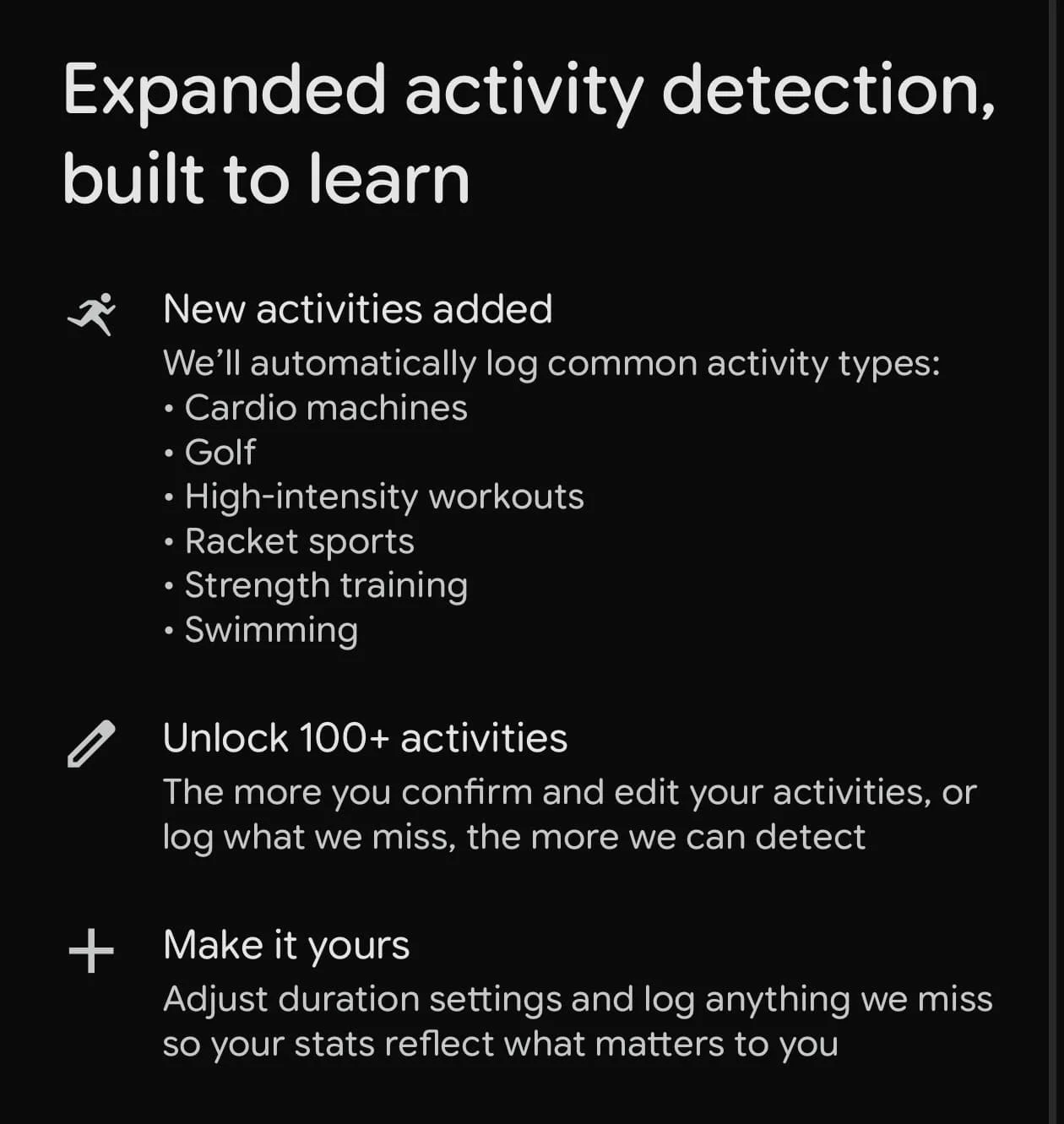
Version 5.11 is widely available on iOS, while the Android rollout is continuing. After updating, users may see an “Expanded activity detection, built to learn” screen. The useful change is the feedback loop: broader recognition can improve as people correct what the app records. If you're working in this space, that design is familiar: detection creates a first draft, and user corrections supply a practical check on the system's assumptions.
Why the expansion matters
This is more significant than it looks for people who don't want to start and stop a workout manually. A tracker that recognizes more kinds of exercise can make activity records more complete, particularly when a session doesn't fit neatly into a short list of common workout types. But convenience depends on the details: whether the system starts at the right time, chooses a sensible label, and makes corrections easy enough that users will bother.
The update also puts more weight on accumulated personal history. If corrections shape later predictions, the experience may become more tailored over time, though Google hasn't described how quickly that happens or whether the improvement is consistent across the newly added categories. The rollout is still underway on Android, and the Fitbit Edge is also due to receive the feature. For now, the practical test is simple: does expanded recognition reduce the cleanup users have to do, or just give them more labels to review? More categories. Fewer missed sessions, if the claims hold up.
Discussion
Sign in to join the discussion.