Two PHP engine flaws are reportedly under active attack after technical details leaked ahead of PHP’s October 21, 2026 security release.
PHP engine flaws put every exposed application in scope
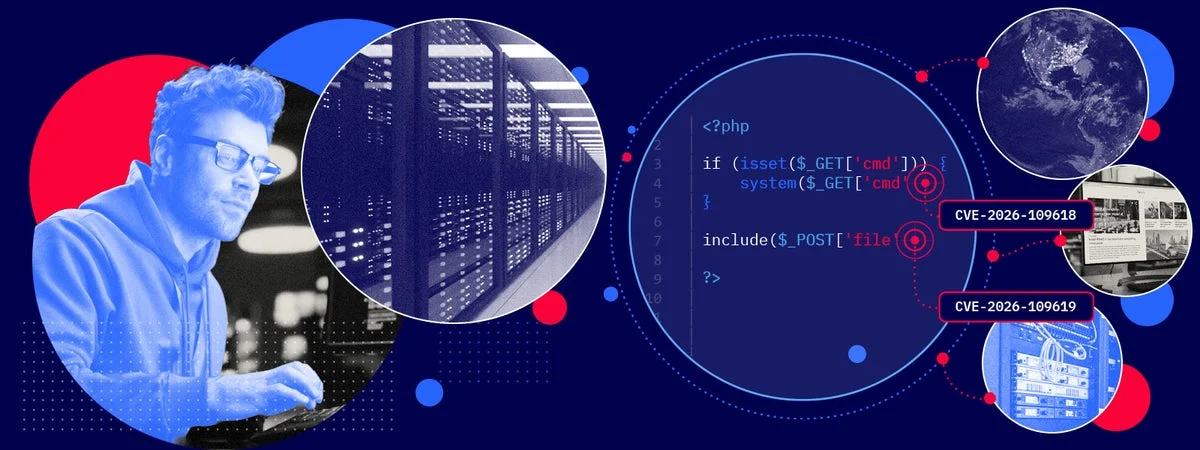
The reported exploitation of two PHP engine vulnerabilities puts websites running affected PHP versions in focus, regardless of whether they use WordPress, Drupal, Joomla, or another platform. CVE-2026-109618 and CVE-2026-109619, dubbed “PHP2Shell,” can enable remote code execution. That changes the question defenders need to ask: the platform’s name may matter less than the PHP version beneath it.
PHP is a server-side programming language: a web server passes certain requests to PHP code, which processes them and returns a response. Content management systems and other web applications can depend on that runtime without exposing its version prominently in their own interfaces. A site may therefore appear to be a WordPress or Drupal installation while the relevant vulnerability sits lower in the software stack, where PHP executes application code.
Remote code execution is a serious class of flaw because it can allow an attacker to make a vulnerable system run code remotely. The source doesn’t describe the conditions required for either PHP2Shell vulnerability, so it’s not possible to say whether exploitation requires a particular configuration, application feature, or kind of request. That uncertainty is a reason to check the vendor’s technical guidance, not a basis for assuming a site is safe.
Why the application’s brand isn’t enough
Organizations often inventory their web properties by application: a marketing site here, a publishing system there, perhaps a separate portal maintained by another team. That view is useful for ownership, but it can miss shared components. Several different applications may rely on the same PHP runtime, and a server may host multiple sites with different maintenance schedules. If you're working in this space, the practical task is to connect each public-facing site to the PHP version and operating environment actually serving it.
That inventory can be harder than it sounds. Hosting providers, managed services, containers, and locally maintained servers can all put version information in different places. A content management system’s administrative screen may not reflect the runtime used by the web server, while a development environment may differ from production. The check needs to reach the system handling real traffic.
This is more significant than it looks: a vulnerability in a shared runtime can cut across teams that think of themselves as operating separate products. The name on the login page doesn’t settle exposure. The underlying PHP installation does.
Early disclosure raises the pressure to respond
The account says technical details reportedly leaked before PHP’s October 21, 2026 security release, followed by active exploitation attempts and public proof-of-concept exploits. It doesn’t specify how much time passed between those events, how widespread the attempts were, or whether any particular organizations were compromised. Those limits matter. “Active exploitation attempts” signals that defenders shouldn’t treat the issue as purely theoretical, but it doesn’t establish the scale or success of attacks.
When details circulate before a patch is available, security teams can face an uncomfortable gap: they may know enough to understand that a flaw is serious without having a reliable way to fix it yet. Once a security release is available, the balance changes. Public proof-of-concept code can help defenders test and validate protections, while also lowering the effort required for others to explore the vulnerability. The source reports that proof-of-concept exploits are public; it doesn’t describe their capabilities or confirm that every affected system is equally easy to exploit.
Timing can also complicate coordination. A website may be operated by one group, its PHP runtime maintained by another, and its hosting managed by a third party. A patch announcement is only the start of the response: someone must identify affected systems, confirm which release applies, schedule deployment, and verify that the running service has changed. Delays often arise in that handoff.
Not just a version check.
What the reported security information can tell operators
Recorded Future says its Insikt Group published further details to customers, and it offers signatures for both flaws through Attack Surface Intelligence. Those are distinct kinds of information. Research details can help organizations understand the reported vulnerabilities, while detection signatures may help identify activity that matches known patterns. The source doesn’t explain what the signatures inspect, how they’re deployed, or what coverage they provide.
That distinction is important in practice. A detection can support monitoring, but it doesn’t update PHP or remove a vulnerable component. Nor should a lack of alerts be treated as proof that a system wasn’t targeted: detection depends on what a tool can observe and recognize. Operators should treat available signatures as one possible input to their security process and follow the PHP release guidance for remediation.
The same caution applies to public exploit code. A proof of concept can help a security team understand and validate a risk, but its existence doesn’t tell operators whether their own systems are vulnerable. Applicability depends on the PHP version and the conditions described in the relevant advisory. The source doesn’t provide those conditions, so organizations need to consult the release information rather than infer them from the “PHP2Shell” label.
Patch, verify, and check the edges
The immediate recommendation in the source is straightforward: organizations running PHP should check their versions and apply the relevant patches. In practice, that means finding the PHP instances tied to production services, comparing them with the affected-version guidance, and deploying the appropriate fixed release where needed. Teams should then verify the version actually running after the change; a completed package update on one host doesn’t establish that every web-facing instance has been updated.
It’s also useful to account for systems that aren’t part of the main application inventory. Old sites, test environments reachable from the internet, and services managed by outside providers can be overlooked during routine patching. Similar software incidents often expose a gap between what an organization believes it operates and what is actually reachable. Here’s the thing: checking the obvious flagship site is only useful if the check covers the full set of PHP-backed services.
If a provider manages the runtime, the organization still needs a clear answer about whether the affected version is present and whether the patch has been applied. That can require coordination, but it’s part of establishing exposure. Where a patch can’t be applied immediately, the source doesn’t offer a workaround or mitigation, so operators should rely on the official PHP guidance for any interim steps rather than assume that generic web protections are sufficient.
Implications for teams that depend on PHP
PHP2Shell is a reminder that a flaw in a widely used runtime can cross product boundaries. A site’s application framework may influence how it’s deployed, but the reported issue is tied to PHP engine vulnerabilities. That makes software inventory and ownership records central to response: security teams need a way to identify the runtime, find who maintains it, and confirm when a fix reaches production.
And yet, the available account leaves important details open. It doesn’t identify affected PHP versions, explain the vulnerabilities’ technical triggers, quantify exploitation, or report confirmed compromises. Readers shouldn’t fill those gaps with assumptions. The sound response is proportionate: treat the reported exploitation as a prompt for immediate version checks and patching, while using the official release information to determine exactly which systems require action.
For organizations with many web properties, the longer-term implication is operational. Runtime versions need to be visible across teams and hosting arrangements, and patch completion needs to be verifiable. That work can’t eliminate future vulnerabilities, but it can make the next response less dependent on hurried discovery. The reported PHP2Shell flaws put that basic discipline back in view.
Discussion
Sign in to join the discussion.