HiDream.ai, a rising star in AI, evolves from static image and video generation to dynamic interactive models, redefining user and enterprise experiences.
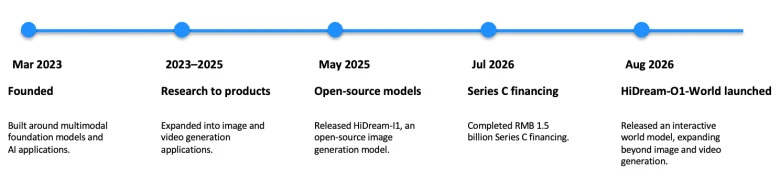
HiDream.ai, founded in March 2023, is quickly turning heads in the AI sector with its progressive approach to generating interactive world models. Under the leadership of founding CEO Tao Mei, a seasoned veteran from Microsoft Research Asia, the startup has shifted gears from traditional content generation to a more immersive, interactive realm. This shift is exemplified by their new model, HiDream-O1-World, which seamlessly integrates various forms of media, enabling a more engaging user experience.
The landscape surrounding AI continues to evolve, particularly as models begin to engage users in interactive environments rather than simply generating static content. Fei-Fei Li’s World Labs notably highlighted this trend, recently raising $1 billion for their omni world model, Atlas, which incorporates text, images, video, and 3D elements into one cohesive system. HiDream.ai's launch of its interactive model on August 16, 2023, marks its commitment to embody this shift. Users can now input text or images to manipulate characters and environments dynamically as scenes progress.
A Closer Look at HiDream.ai’s Model Evolution
Upon its debut, HiDream-O1-World quickly made an impression by securing an 80.9 score on WBench’s Navi leaderboard, initially ranking first among competitors. By September 15, despite a competitive boost from other models, it remained firmly in the top tier, settling at No. 6. Despite the rapid influx of new technologies, HiDream.ai’s dedication to building generative multimodal models stands out.
Mei’s prior experience led him to assemble a skilled team where over 90% hold advanced degrees. As a former vice president at JD.com, where he spearheaded computer vision initiatives, Mei recognized the importance of forming a solid foundation from which to innovate. This strategy allows HiDream.ai to lower its training costs significantly—estimated at one-fifth of the industry average—while balancing resources amid evolving technological demands.
Strategic Beginnings and Funding
HiDream.ai's early funding sources included a group of 15 alumni from the University of Science and Technology of China, allowing the startup to accumulate approximately RMB 100 million through two funding rounds completed by December 2023. Their product lineup started with Pixeling and PixMaker, platforms aimed at enhancing visual creation in e-commerce. Not initially, the foray into video production presented challenges, and Mei candidly described their first video model as “terrible.” However, the team pivoted towards a Diffusion Transformer architecture, sharpening their tools in response to industry trends.
The company’s development strategy involved parallel work on image and video technologies, optimizing the scalable and cost-effective image model to validate ideas before venturing into more resource-intensive video solutions. This dual-focused approach has become key, allowing HiDream.ai to refine its technology and accelerate its path to commercialization.
Adapting to Market Demands
Initially, HiDream.ai believed that advanced model capabilities alone would entice enterprise users. However, market feedback revealed companies preferred ready-to-use applications rather than standalone models. This lesson shifted their approach, illustrating the transition to a more comprehensive software solution where workflow solutions integrated smoothly with their generative models.
The shift was particularly pronounced in the e-commerce sector where initial offerings of static product images proved limiting. Instead, the focus turned toward content-driven marketing strategies that require frequent production of engaging material, often demanding thousands of unique video pieces monthly. Consequently, HiDream.ai has realigned its business model experimentation. They have explored subscription services, content partnerships, and even revenue-sharing frameworks which align closely with business performance metrics. Their “1+1+3” strategy encapsulates a drive to blend model technologies, enterprise tools, and modular application offerings.
Performance Metrics and Competitive Positioning
HiDream.ai maintains a keen eye on performance metrics, understanding the dual necessity of achieving both price efficiency and absolute performance. The startup relies on its model-development cycle to optimize production costs, with Mei asserting in a 2025 interview that they’ve driven down training expenses while also projecting a dramatic reduction in video inference costs.
They recently announced that their tools could cut the traditionally high costs of creating commercial short videos to a fraction, illustrating how nimble startups can compete effectively against industry giants. Their image model, HiDream-O1-Image-1.5, has garnered attention by reaching the top positions across various text-to-image leaderboards before settling at No. 16 as of September.
Investments and Future Prospects
In a recent funding spree, HiDream.ai raised RMB 1.5 billion in July, pushing total financing over three months to more than RMB 2.1 billion. Investor Wang Bing from Oriental Fortune Capital emphasized HiDream.ai's potential due to its strategic positioning in developing cost-effective foundational models designed for rapid enterprise integration—a critical value in the current tech ecosystem.
Furthermore, the startup's robust collection of licensed visual data, with 200,000 hours sourced through partnerships, positions it favorably in a competitive field with copyright concerns hanging large. However, the path ahead is demanding; talent, data, and computational resources pose ongoing economic hurdles, with Mei aiming for monthly profitability by 2029.
A Pioneering Path Forward
HiDream.ai illustrates a unique trajectory distinct from that of companies like Google DeepMind, which leverages a vast consumer ecosystem for broader reach. Instead, HiDream.ai places enterprise solutions at its core, methods tailored to serve business clients through practical, results-oriented software services.
The company's focus on generating ongoing content rather than one-off projects exemplifies a strategic move aimed at continuous client engagement. As of early 2026, over 30 million professional users and more than 40,000 enterprise clients worldwide engaged with HiDream.ai, marking a significant milestone for the young enterprise.
The leadership transition reflects a learning journey. While Mei maintains a commitment to scientific rigor, the necessity of crafting a compelling business narrative has not gone unnoticed. His acknowledgment of the need for a more assertive brand presence sets the tone for upcoming initiatives. As HiDream.ai forges ahead, success will hinge on how effectively it bridges the gap between advanced research, actionable enterprise solutions, and a resonant market narrative.
Have a startup we should know about? Reach us at [email protected].
Discussion
Sign in to join the discussion.