Explore essential strategies for AI startups to garner investor attention and recruit skilled talent in their challenging first year.
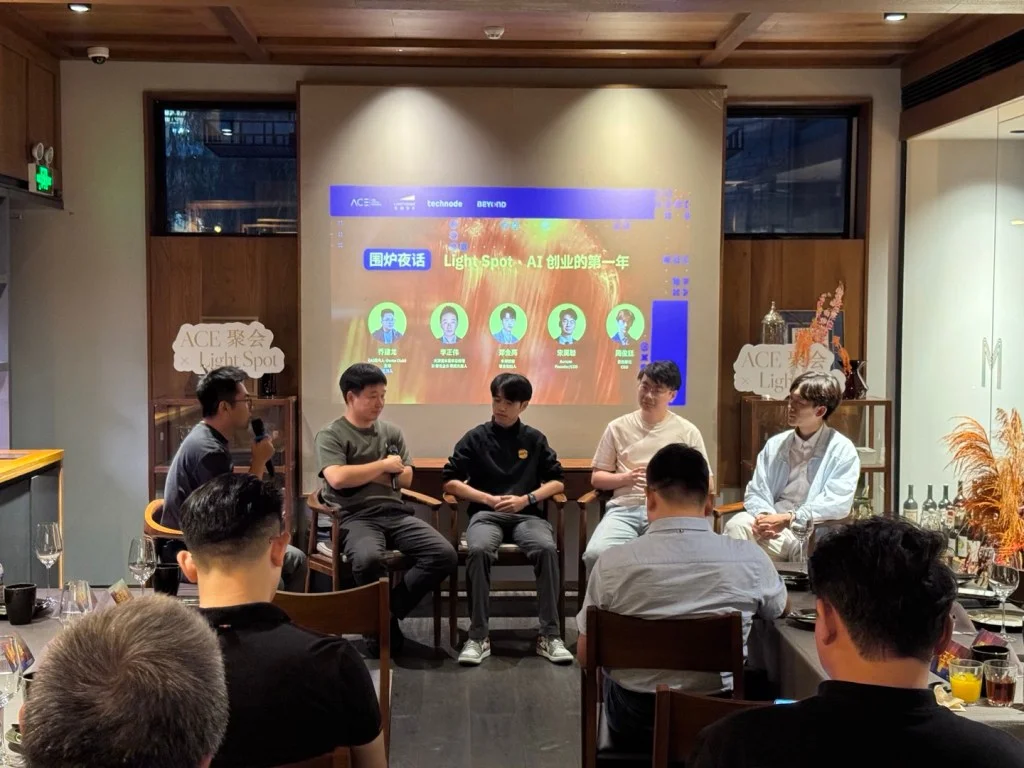
On September 16, TechNode convened a roundtable in Beijing, teaming up with Asia Capital Exchange (ACE), Lighthouse Capital, and BEYOND, titled “ACE Gathering x Light Spot: The First Year of AI Startups.” The event, moderated by AI Insider’s Demo Club editor Qiao Jianlong, featured insights from several founders and industry experts.
Among the participants were Zheng Jinliang, co-founder of BASAL INTELLIGENCE; Song Haocong, CEO of Aurano; Zhou Junting, CEO of Lingqi Xiyuan; and Li Zhengwei, managing director at Lighthouse Capital. A recurring theme from these discussions was the paradox that many fledgling startups face: how to make investors and talented individuals seek them out instead of always chasing after them.
The Dynamics of Startup Fundraising
Li Zhengwei's extensive experience in startup fundraising provides valuable lessons. Since joining Lighthouse Capital in 2016 and his subsequent return this year, he has seen the funding ecosystem diversify dramatically. Current market conditions create a scenario where some startups attract considerable investor interest while others struggle to gain traction.
According to Li, direct outreach from investors substantially increases the likelihood of securing an investment. He asserts that founders relying solely on cold calls may often find it unproductive. Instead, building relationships with influential individuals who can introduce the startup to potential investors can lock in interest more effectively. Li advises founders to cultivate these connections, securing thoughtful introductions to three to five key investors.
Trust plays a pivotal role in early-stage funding. Most emerging startups initially rely on funding from friends and family, leveraging existing personal credibility. However, if these founders fail to demonstrate tangible progress within their first six months, their ability to raise additional funds diminishes. Establishing a solid team and a clear vision early on is central to successful fundraising.
Pioneering Unique Product Concepts
Before exploring funding avenues, a startup needs a well-defined direction. Simply jumping on the latest tech trend often leads to a crowded marketplace. As Song Haocong observed, the shift towards text-centric human-computer interactions can make processes tedious. Therefore, finding a niche within this domain through a strategic approach can stand out amidst the noise.
Song employs what he refers to as a “three-step” methodology during product development. This strategy encourages founders to envision their product's future value while considering underlying market needs. By identifying smaller, less-traveled paths in product development, entrepreneurs can reduce competition. As Song states, creating an offering that appears minor today could yield substantial returns as surrounding market conditions evolve.
Equally ambitious, Zheng Jinliang's vision revolves around the intricacies of embodied AI. His focus is on the intelligence that drives AI systems rather than the robotics hardware, carving a niche in an area poised for significant growth. From his perspective, tackling foundational AI challenges could unveil opportunities before larger players saturate the field.
Zhou Junting’s project, Lingqi Xiyuan, shifts the focus to enhancing scientific processes through AI. He proposes an infrastructure where AI learns continuously through interaction with real experiments, integrating research hypotheses directly into laboratory work. This vision pushes forward the practical application of AI beyond conventional frameworks.
Building a Committed Team
Once a viable idea is in place, attracting the right talent becomes critical. Each entrepreneur at the roundtable shared their strategies for assembling effective teams. For Song, it’s about identifying individuals with conviction who are willing to navigate uncertainty. He emphasizes the importance of maintaining a research-centric environment to nurture talent through continuous learning.
Zhou illustrates a proactive approach by leveraging his university surroundings to recruit dedicated team members who already share his vision, which often results in a more committed and aligned team. Zheng echoes this sentiment, focusing on recruiting individuals who have firsthand experience in the complexities of AI research, ensuring that they can tackle the tough questions.
From an investment perspective, Li highlights the evolving expectations of teams in today’s market. Beyond just understanding user demand, success now hinges on technical expertise and sound business acumen. Without this blend, startups may struggle to convert ideas into marketable products.
Finding Undervalued Opportunities
In a landscape dominated by massive tech companies, founders must remain vigilant for opportunities that larger entities might overlook. Song points to the importance of identifying areas that may not immediately attract big companies but have the potential for growth. Understanding the nuances of market demand can guide startups away from direct competition.
Similarly, Zhou contemplates the potential for cooperation rather than rivalry. AI for Science presents uncharted territories where collaboration with established giants could foster innovation without direct competition. Zheng proposes that the complexity of embodied AI allows small teams to experiment and innovate in ways that larger firms cannot.
Creating an Attractive Startup Culture
So, what does success look like in the first year for an AI startup? The commitment of the core team emerges as a major predictor of longevity. Founders need to cultivate a culture that inspires conviction and resilience even in challenging circumstances. Li points out that many startups fail due to a lack of focus on their initial mission, often leading to uninspired teams.
The transition toward a Series A funding round is fraught with uncertainty, requiring startups to adapt continuously to shifts in technology and market demands. Li's incubator aims to see half of its projects reach this critical milestone within two years, setting a high bar for success amidst numerous challenges.
Qiao Jianlong optimistically noted the varying pathways within AI and tech. Unlike previous tech eras marked by winner-takes-all dynamics, the AI sector presents numerous specialized niches, broadening the potential for diverse success stories. The emphasis should be on drawing investors, talent, and end-users toward your vision while creating a distinct space amid competition from larger firms.
The real accomplishment during a startup's first year lies not just in securing funding or developing technology, but in fostering a compelling vision that resonates with others. The challenge is to inspire enough belief in your team and your concept that they become the driving force behind your startup’s success.
Discussion
Sign in to join the discussion.