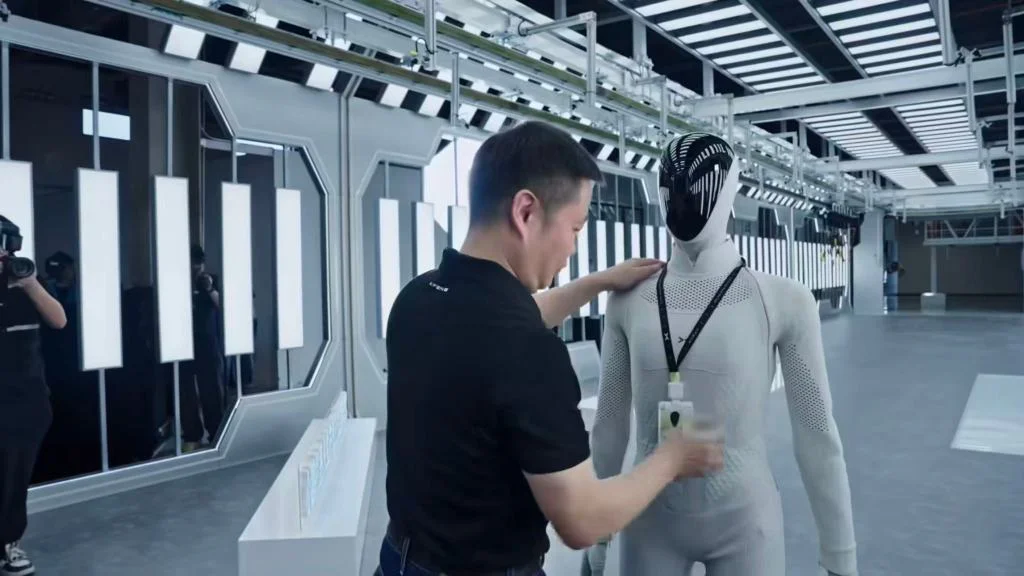
XPeng's IRON humanoid robot has completed its first autonomous walk off an automated production line, signaling a shift towards mass production and commercialization.
XPeng's Milestone in Humanoid Robotics
XPeng has officially initiated operations on its automated production line for humanoid robots, culminating in the first IRON robot autonomously walking off the assembly line. This development represents a significant shift from research and development to mass production, positioning XPeng at the forefront of the humanoid robotics sector. The transition marks a momentous occasion not only for the company but for the entire industry as well, indicating a potential pivot toward more practical applications of robotics in daily life.
The IRON Robot: A First in Automated Production
According to XPeng, IRON stands out as the world’s first high-level, general-purpose humanoid robot manufactured on an automated production line. This line was meticulously designed by XPeng’s in-house team, incorporating quality control and manufacturing systems tailored from the automotive industry to meet the detailed demands of humanoid robot assembly. Impressively, more than 80% of the core processes on this production line are automated, showcasing a commitment to efficiency. The decision to borrow practices from automotive manufacturing speaks volumes about the seriousness with which XPeng approaches scalability—a key factor in robotics that remains an unsolved problem for many developers in this burgeoning field.
Challenges and Future Potential
Despite the advancements, the commercialization of humanoid robots is still in its nascent stages. Many existing products struggle with large-scale production due to extensive manual assembly processes. This presents a dual challenge: transitioning to fully automated lines while ensuring product precision. The effectiveness and economic feasibility of such mass production methods have yet to be fully validated. The brunt of the issues falls primarily on the complexity of robot construction. Factors like intricate components and the need for precise calibration in a humanoid design remain hurdles that could derail rapid adoption. If you're working in this space, you'll understand that these aren't merely technical challenges; they also encompass supply chain logistics, labor skill levels, and market acceptance.
Capabilities and Design of the IRON Robot
IRON is conceived as part of XPeng’s physical AI strategy, designed to function in diverse real-world settings with a wide range of tasks. This humanoid robot boasts a fully enclosed flexible lattice structure that provides it with 76 degrees of freedom, including 21 in its hands. Its computational prowess comes from three Turing AI chips, which collectively deliver up to 2,250 TOPS of computing performance. Notably, IRON's local AI model allows it to perceive its environment and execute tasks autonomously, negating the need for human intervention. While this level of dexterity and intelligence is promising, the real test lies ahead: how these capabilities translate into everyday household or industrial tasks. Will the robot genuinely integrate into human environments, or will its performance remain limited to specially designed scenarios?
Commercialization Roadmap
XPeng's roadmap outlines plans for IRON to enter scaled production by the end of 2026, with commercial deliveries targeted for 2027. Initially, the robot is expected to undertake dangerous or repetitive tasks, but ultimately, its application range is set to expand significantly. The strategy to focus first on arduous jobs reflects an understanding of market needs; many sectors are looking for automation solutions that can alleviate the danger of risky jobs and the monotony of repetitive tasks. That said, the timeline seems optimistic given the historical challenges related to integrating advanced robotics into workforces.
Funding and Strategic Vision
In its pursuit of commercializing robotics, XPeng recently secured over $900 million in funding for this sector, achieving a post-money valuation exceeding $6.3 billion. The funding, led by IDG Capital and supported by significant investments from Tencent and Alibaba, underscores the growing interest and potential in the robotics market. However, such massive financial backing can also suggest a bubble. The swift influx of capital often compels companies to rush their projects—resulting in trials that don’t meet expectations once a product hits the market. Skepticism surrounds many such ambitious ventures, but XPeng seems well-positioned to navigate these pitfalls with its extensive automotive background.
Looking Ahead
He Xiaopeng, CEO of XPeng, articulates a vision where these humanoid robots will be “more human-like and safer,” capable of natural interaction and powered by their own memory systems. The ambition extends beyond mere prototypes, aiming to deliver products that create tangible value in everyday environments. This statement echoes a broader trend in robotics—moving from purely functional design to crafting machines that can genuinely interact with humans. It’s an admirable goal, yet the “human-like” aspect remains dubious for many; after all, how close can technology get to replicating human interaction? As the technology evolves, so too will public perception and acceptance, which could either bolster or hinder XPeng's aspirations.
Implications for the Future of Robotics
The implications of XPeng's advancements in humanoid robots are far-reaching. As more companies enter this arena, we may witness a cascading effect—a push for improved technology that meets consumer and industrial demands. However, adapting to new technologies often requires changes in infrastructure, labor markets, and even policy frameworks. The real question remains: are we ready to integrate humanoid robots into our lives, and what are the social consequences that follow? The evolution of robotics, driven by companies like XPeng, might soon challenge traditional employment models and interpersonal norms. In this context, the roadmap for humanoid robots won't just be about tech specifications and production timelines; it'll also be about navigating the societal shifts these machines will provoke.
Discussion
Sign in to join the discussion.