The Unitree GD01 represents a pivotal shift in robotics, focusing on versatile applications over mere mobility, reflecting the industry's evolving priorities.
Unitree Robotics Takes Center Stage
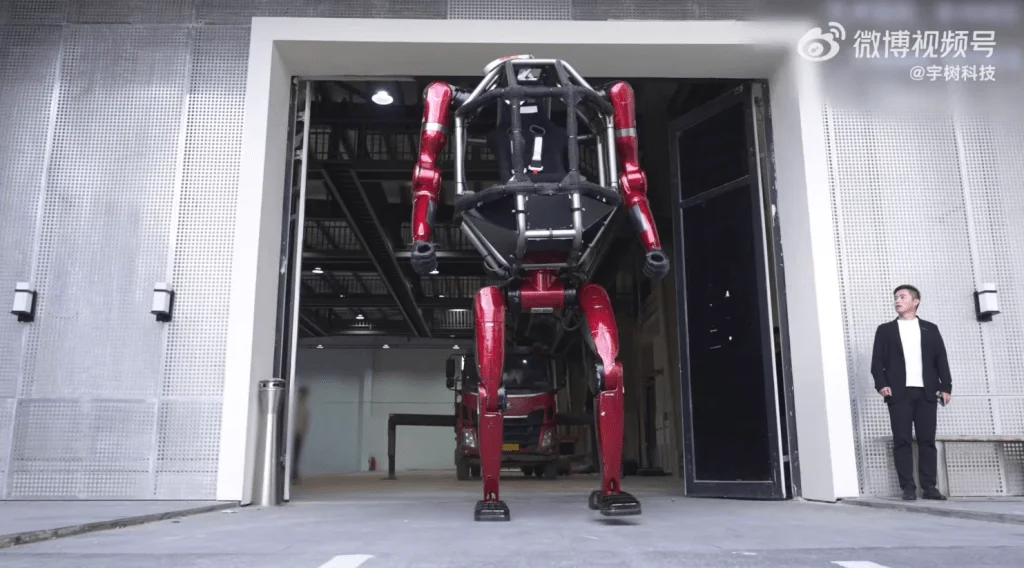
In 2026, Unitree Robotics made headlines again, this time with its GD01 manned mech featured prominently on the cover of TIME magazine, alongside founder and CEO Wang Xingxing. Standing at nearly 2.7 meters tall, the GD01 dominates the cover, casting a spotlight on both the machine's impressive stature and the technological advancements it's showcasing.
Breaking New Ground in Manned Robotics
Boasting the title of the world’s first mass-produced manned mech, the GD01 weighs around half a ton and offers a cockpit located within its torso. This engineering marvel can transition between two-legged and four-legged movement, with fists strong enough to break through obstacles. Its legs, crafted from red carbon-fiber, provide stability and durability through heavy-duty mechanical hinges.
A Paradigm Shift in Robotic Design
While preceding models from Unitree catered primarily to research, education, and industrial applications, the GD01 steps into a realm that pursues robust performance in dynamic environments. This model represents a significant transition in robotics—moving from single-function designs toward versatile platforms capable of navigating complex surroundings.
Implications for the Robotics Industry
The initial reception to the GD01 highlighted its resemblance to sci-fi concepts, yet the real intrigue lies in its implications for the industry. It signals a shift from competition over robotic design to competition about functionality—essentially, what those machines can achieve in the real world.
Designed for Diverse Scenarios
The GD01 is strategically positioned between conventional industrial and consumer robots. Its unique ability to adapt movement—bipedal or quadrupedal—allows it to tackle various terrains and situations, such as emergency response, inspection tasks, and future mobility challenges in complex environments.
Overcoming Mobility Limitations
In contrast to traditional automated systems bound by fixed pathways or structured settings, the GD01 is engineered to expand the horizons of robotic mobility. It aims to enhance operational capabilities in unstructured environments, which could revolutionize how robots are deployed in niches like hazardous working conditions and specialized inspections.
Advancing Capabilities in Robotics
The journey through robotics in China has reached a significant inflection point, with advancements emerging in quadrupedal and humanoid robot mobility. Companies, including Unitree, have refined their focus from mere movement to addressing how robots can perform valuable tasks in various sectors, challenging the status quo of robotic capabilities.
Looking Beyond Mobility
The development of the GD01 underscores a fundamental shift in competitive advantage. It's not enough for robots to move well; they must now demonstrate their utility in real-world applications. As the field grows, the focus is clearly on building intelligent machines that provide tangible economic advantages rather than just technological showcases.
The Emerging Competitive Landscape
In the past, comparisons were drawn between robots based on technical specs like speed and joint mobility. However, future competition may hinge on a robot's environmental understanding and task execution, supported by advanced AI systems. This evolution could redefine success in robotics.
Broader Implications for the Future
Although the GD01 may not dominate in production volumes, it serves as a key indication of the direction of China's robotics sector. This mech encapsulates a pivotal moment, corresponding with a broader trend: robots are transitioning from controlled environments into versatile, real-world applications.
Challenges on the Horizon
Despite these advancements, significant hurdles remain before robots can integrate seamlessly into daily life. These challenges include high production costs, safety protocol development, battery efficiency, and the reliability of commercial applications. Addressing how to produce robots economically and gather valuable operational data will be essential for future advancements.
A New Direction for Robotics
As we look ahead, sectors such as industrial automation, hazardous environment response, and professional services stand out as the most viable avenues for robotic deployment. The evolving focus in the robotics industry is becoming clear: past questions around robot mobility will be overshadowed by the pressing need to develop robots that generate real, practical value over the next decade.
Discussion
Sign in to join the discussion.