Insikt Group highlights a significant rise in critical vulnerabilities, including a notable SQL injection flaw exploited in Ghost CMS attacks.

In May 2026, Insikt Group identified 41 high-priority vulnerabilities warranting immediate attention due to their Very Critical Recorded Future Risk Scores. This marks an 11% uptick compared to the previous month, highlighting an ongoing escalation in cybersecurity threats.
These vulnerabilities span products from 20 different vendors, with Vercel notably responsible for about 27% of them. This concentration is largely due to attack patterns involving the Next.js framework, which are indicative of broader vulnerabilities in enterprise software, security applications, networking tools, and cloud services. The prominence of such frameworks shows the need for vendors to adopt more stringent security practices, particularly in today’s environment where software development has rapidly outpaced traditional security measures.
Summary of Actively Exploited Vulnerabilities
Among the 41 vulnerabilities identified this month, 21 are classified in the US Cybersecurity and Infrastructure Security Agency (CISA)’s Known Exploited Vulnerabilities (KEV) catalog. Additionally, 19 of these vulnerabilities were detected using honeypot data, while one came from a cybersecurity vendor's report. These figures signal an urgent need for organizations to prioritize patch management and ensure adequate defenses against these vulnerabilities. As organizations continue to adopt various platforms and services, understanding which vulnerabilities are actively being exploited becomes crucial in forming a comprehensive security strategy.
The following table serves as a quick reference for vulnerabilities that were actively exploited in May 2026. It excludes those sourced from honeypot activities that are available exclusively to Recorded Future clients through the monthly CVE Report. Each entry includes potential public proof-of-concept (PoC) exploits.
| # | Vulnerability | Risk Score |
Vendor/Product | KEV | Malware Analysis | RCE | PoC |
|---|---|---|---|---|---|---|---|
| 1 | CVE-2008-4250 | 99 | Microsoft Windows | ✓ | ✓ | ✓ Link | |
| 2 | CVE-2009-1537 | 99 | Microsoft DirectX | ✓ | |||
| 3 | CVE-2009-3459 | 99 | Adobe Acrobat and Reader | ✓ | |||
| 4 | CVE-2010-0249 | 99 | Microsoft Internet Explorer | ✓ | ✓ Link |
Table 1: Summary of critical vulnerabilities actively exploited in May 2026 according to Recorded Future data.
Emerging Threats and Attack Trends
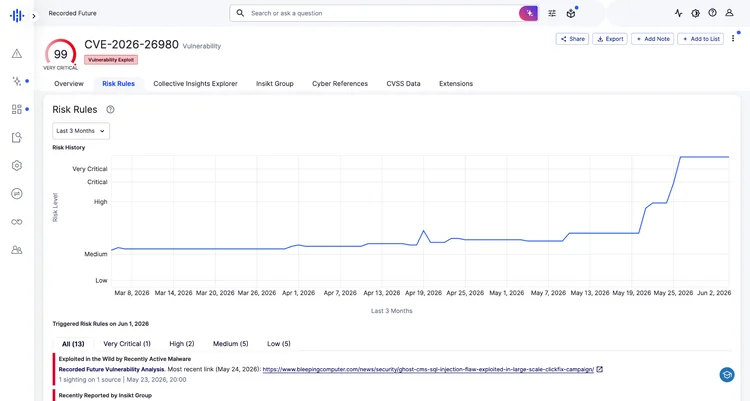
- Threat actors exploited CVE-2026-26980, a critical SQL injection vulnerability within the Ghost CMS, significantly impacting large-scale ClickFix poisoning campaigns.
- The campaigns leveraged compromised Ghost CMS instances to inject malicious JavaScript, manipulating victims through social engineering techniques. This highlights a troubling trend where attackers exploit trusted platforms to amplify the impact of their operations.
- A total of 12 out of the 41 vulnerabilities allowed for remote code execution (RCE), affecting products from vendors including Microsoft, Adobe, Langflow, and Palo Alto Networks. The ability to execute code remotely often leads to more severe breaches, giving attackers greater freedom to maneuver within affected systems.
- Insikt Group highlighted that 32 of the reported vulnerabilities have publicly available proof-of-concept exploits, increasing the urgency for organizations to patch their systems. With easy access to these exploits, the window of opportunity for attackers narrows only when organizations act swiftly.
- Prominent vulnerabilities were linked to common flaws, primarily CWE-79 (Cross-site Scripting), CWE-506 (Embedded Malicious Code), and CWE-89 (SQL Injection), each with three occurrences this month. Understanding these patterns can help guide organizations in strengthening their defenses against such attack vectors.
- Notably, five vulnerabilities reported are from between 2008 and 2010, underscoring the persistent issue of exploited older weaknesses in environments where updates are neglected. This is more significant than it looks. It implies that even companies prioritizing security may unknowingly expose themselves to years-old vulnerabilities.
In-Depth Exploit Analysis
This section sheds light on some of the most impactful vulnerabilities actively being exploited this month, particularly those tied to known campaigns or supported by public exploits. Recognizing these vulnerabilities isn’t just for academic interest; these are threats that could manifest into serious breaches if organizations do not take action.
Case Study: CVE-2026-26980 in Action
CVE-2026-26980 is a high-risk SQL injection vulnerability affecting Ghost CMS, enabling threat actors to extract admin API keys and edit website content without authentication. On May 21, 2026, cybersecurity firm XLab detailed how this vulnerability was exploited in extensive ClickFix poisoning campaigns that ensnared over 700 compromised Ghost CMS websites across diverse sectors including blockchain and fintech. The scale of this attack reveals not just the vulnerability in the software but also how exploitative attacks can transcend industry boundaries and target a wide range of users.
The campaigns utilized compromised websites to conduct social engineering attacks targeting users’ systems. For instance, malicious payloads like UtilifySetup.exe were found during this exploitation cycle, reflecting serious compromises. These payloads not only facilitated DLL injection attacks but also gathered vital system information, showcasing the multifaceted approach of the attackers. The attackers' strategy here isn’t just to infiltrate but to control systems, which often proves more detrimental to organizations.
Recorded Future clients can access further technical details and analysis of the exploits related to CVE-2026-26980, including methods of detection and mitigation strategies. It’s essential for organizations to not just patch systems but also to monitor for any signs of compromise post-attack.
Implications for Organizations and Future Outlook
The cybersecurity sphere isn’t going to stabilize any time soon. The findings from May 2026 make it evident that companies must rotate their security priorities. While vulnerabilities from years past still pose threats, the rapid pace of modern attack techniques outstrips many organizations' ability to respond. If you're working in this space, an effective strategy involves not only patch management but also employee education. Many vulnerabilities are exploited through user error, making awareness training just as important as technological defenses.
The persistent exploitation of older vulnerabilities is a stark reminder that organizations cannot afford to rest on their laurels. The focus on emerging threats should not dull attention to the basics of security hygiene. Neglected older vulnerabilities may lead to widespread breaches, and organizations must take it upon themselves to ensure consistent monitoring of their all systems.
As long as threat actors find success, they won’t stop innovating. Anticipating future attacks could include examining past behavior and adjusting security policies accordingly. The cybersecurity environment is challenging, yes, but understanding these vulnerabilities is a step toward fortifying defenses.
Discussion
Sign in to join the discussion.