Recorded Future's new dashboard simplifies showcasing security intelligence value, helping teams communicate risk reduction to business leaders effectively.

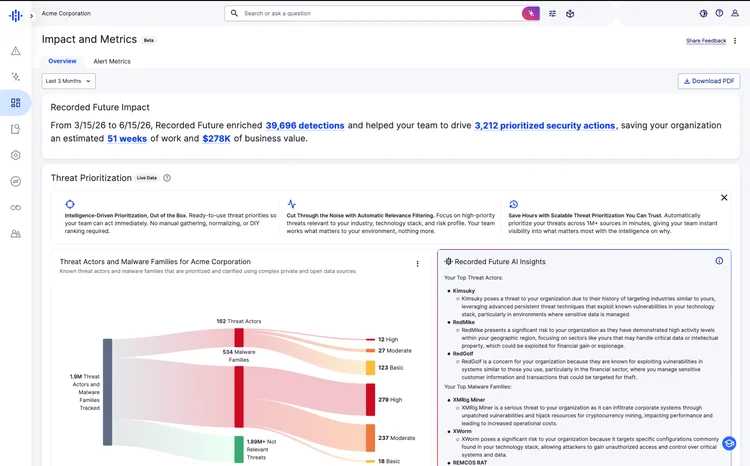
Recorded Future has unveiled its Impact and Metrics Dashboard, enabling customers to visualize the value generated by their intelligence programs dynamically. This new tool eliminates the need for manual report generation, integrating data from alerts, integrations, threat intelligence, and analyst activities to highlight key metrics that resonate with business and security priorities.
Challenges in Communicating Security Value
Security teams understand the impact of intelligence on outcomes, yet articulating that value to non-technical stakeholders often proves challenging. Decision-makers such as the board, CFOs, and CIOs require insights beyond mere threat counts. They seek tangible metrics linking risk management to business context—numbers that can be defended and understood at a strategic level. This disconnect can lead to underfunding of security initiatives, or worse, cybersecurity becoming an afterthought in corporate strategy debates—a scenario that's increasingly worrying as cyber threats become more sophisticated.
Success in cybersecurity shouldn’t solely rest on the technical expertise of security teams. Rather, it's the ability to translate technical achievements into business value that determines a program’s longevity and support. This creates a significant challenge. If you’re working in this space, not being able to communicate effectively with stakeholders means your accomplishments might go unnoticed or, even worse, be undervalued.
The Dashboard's Promising ROI Figures
According to the 2025 ROI Report—validated across almost 300 clients—Recorded Future customers have reported an impressive 351.3% annual ROI. Additionally, 57% acknowledge significant reductions in overall cyber risk, with a remarkable 96% recommending the service to their peers. These figures are compelling, but they prompt deeper questions: What methodologies were used to calculate these numbers? And can such metrics be generalized across different industries or sizes of organizations?
The striking part isn’t just the averages but the specific threats mitigated due to intelligence-driven actions. For instance, incidents of ransomware averted before execution or credential resets carried out ahead of exploitation don't just represent figures—they embody real-world risks that could have catastrophic outcomes. Historically, compiling these success stories meant manually extracting and assembling data quarterly, which was time-consuming and inefficient. The Impact and Metrics Dashboard aims to streamline this process significantly.
Dashboard Features
Central Security Value: Offers a summarized visual representation of aggregate risk reduction and intelligence application across the organization, tailored for presentations to leadership. This feature is not merely about numbers; it's about visually communicating the security story that gets board members' attention.
Threat Prioritization: Allows organizations to pinpoint relevant threat actors and malware groups while leveraging Recorded Future’s AI to minimize noise, enabling teams to identify new threats 65% faster. This speed could mean the difference between thwarting a major attack or directly experiencing its aftermath.
Threat Detection: Tracks the flow of intelligence through your security infrastructure, showcasing malware detections and threat hunting endeavors. Many customers have reported critical alerts that they received significantly earlier than those from competing vendors. Speed in threat detection has become vital in a landscape where attackers are becoming more brazen and sophisticated. The sooner you identify a threat, the sooner you can implement necessary countermeasures—and that can’t be overstated.
Digital Risk Protection: This feature quantifies the reduction in exposures related to fraud, brand impersonation, and credential threats. For organizations facing substantial brand or customer risk, these insights quickly translate to ROI that is easily communicated to financial executives. Bottom line: if you can show how reducing risks directly connects to protecting revenue and brand integrity, your case becomes much more compelling.
Account & Credential Monitoring: Enables the identification and resolution of identity threats before they escalate into larger incidents. This proactive approach is essential as identity theft and credential-related breaches continue to rise, significantly impacting organizations over time.
Insight from Recorded Future AI & Insikt GroupⓇ Research: The expertise of Recorded Future’s dedicated intelligence team and AI simplifies the analysis process, providing insights that individual teams may struggle to achieve alone. This aspect allows users to quantify analyst hours saved through AI-driven automation, creating a distinct efficiency narrative through measurable data. It’s not just about speed; it’s about ensuring that teams can focus on more strategic tasks by letting automation handle routine data gathering.
Future Implications
The dashboard is now available to all customers, positioned to facilitate meaningful conversations and provide valuable metrics. As organizations become increasingly aware of their digital vulnerabilities, tools like this could play a pivotal role in decision-making processes. With time, customization will deepen, enhancing the relevance and specificity of benchmarks and integration with unique business contexts. The world of cybersecurity is not static; as threats evolve, strategies must adapt. This dashboard could very well set a new standard for how organizations assess the value of their cybersecurity investments.
As cybersecurity increasingly takes center stage in corporate governance, the ability to showcase return on investment will be essential. The implications stretch beyond just security metrics; they can redefine the conversation around what effective cybersecurity looks like, potentially reshaping how organizations allocate budgets and resources in an era where cyber threats are growing exponentially.
Discussion
Sign in to join the discussion.