TAG-195 introduces four new modular malware families that enhance operator capabilities and mark a strategic shift in malware architecture.
Executive Overview
Recent insights from Insikt Group reveal the emergence of four malware families—namely TinyEgg, ChonkyChicken, a modular variant of ChonkyChicken, and ChromEggscalator—within the TAG-195 malware-as-a-service (MaaS) environment. This development showcases a significant evolution in TAG-195's capabilities, previously linked to operators such as TAG-127. These operators have deployed TinyEgg through deceptive "ClickFix" campaigns, designed to lure victims into unknowingly executing malicious commands through familiar Windows utilities. This strategic use of existing software tools highlights a cunning approach to social engineering and exploitation.
The new malware families reflect an architectural shift within the TAG-195 ecosystem, marking an increasingly sophisticated set of tools that demonstrate the ability to adapt to changing cybersecurity landscapes. TinyEgg serves as a lightweight initial-access backdoor, targeting hosts by facilitating profiling, offering interactive shell access, and managing persistence without alerting users or defenses. ChonkyChicken enhances these features with tools for browser credential theft, session automation, and extensive reconnaissance functionalities, dragging the murky waters of remote exploitation deeper. Notably, the modularized version of ChonkyChicken introduces a controller-and-plugin architecture. This flexibility allows for the dynamic loading of capability modules from attacker-controlled infrastructure instead of depending on a single, monolithic implant, which poses significant challenges for detection and mitigation strategies used by cybersecurity professionals.
In addition, Insikt Group has identified ChromEggscalator as a modified version of a publicly available Chrome encryption-bypass tool, which has now found a malicious purpose within this malware family. The repurposing of existing tools in this way not only reflects resourcefulness on the part of cybercriminals but also raises alarms about the exposure of such tools when they are misused.
All four malware families share identifiable architectural characteristics such as standardized command-and-control protocols, consistent persistence strategies, string obfuscation methods, and uniform execution approaches across common delivery systems. This interconnectedness hints at a collaborative evolution among these malicious entities, further complicating the responses from security teams striving to protect organizations.
Key Insights
- The identification of TinyEgg and ChonkyChicken—alongside its modular counterpart and ChromEggscalator—highlights ongoing, deliberate development within TAG-195, steering towards modular, operator-centric solutions. These developments signal the group's dedication to refinement, vastly enhancing their arsenal's effectiveness.
- The modular ChonkyChicken employs a controller-based architecture, allowing for the selective engagement of at least fourteen functional modules as needed. This design effectively minimizes the base implant's detection potential while optimizing operational efficiency for threats, rendering traditional security measures less effective against these meticulously designed tools.
- Shared architectural traits across these malware families—such as filename execution gating, Run key persistence under consistent value names, string obfuscation, and execution leveraging legitimate Windows binaries—reinforce their interconnected lineage within the TAG-195 ecosystem. Such consistent design choices indicate a level of sophistication that must be addressed by evolving security measures.
Contextual Background
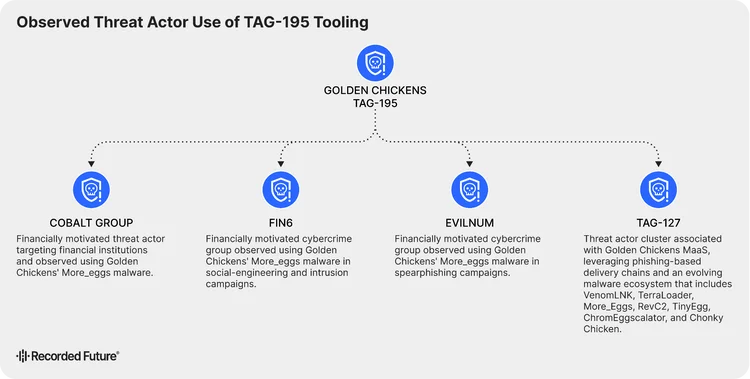
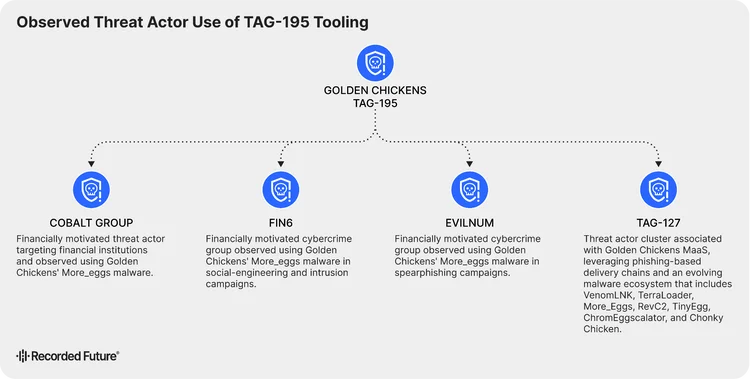
TAG-195, known colloquially as “Golden Chickens” or "Venom Spider," stands out as a financially motivated operation within the MaaS domain. This group has long been associated with providing illicit credential theft and remote access tools to various criminal entities. Its ongoing activities, including the malware's accessibility for multiple threat actors and the sustained evolution of its tooling across generations, signal its significant role as a prominent MaaS provider. Reports from eSentire have tied TAG-195 to notable criminal groups such as FIN6, Cobalt Group, and Evilnum, indicating that its services cater to a select clientele, albeit details surrounding their sales and access frameworks remain obscure.
It's alarming to consider the implications of such a well-organized operation. If you're working in this space, knowing that TAG-195's services are available to a wide range of criminal actors should strike concern. Insikt Group continues to track TAG-127, which incorporates TAG-195 MaaS offerings and utilizes delivery mechanisms like ClickFix and VenomLNK. The flywheel of this operation continues to turn, creating an environment where even less skilled actors can access powerful tools with limited barriers to entry.
Implications and Future Outlook
The emergence of these malware families comes at a time when cyber threats are increasingly sophisticated, and organizations are grappling with an overload of security alerts. The modular design of malware like ChonkyChicken suggests that attackers are conceiving strategies that make detection increasingly difficult. In a world where traditional security measures often fall short, adaptability to these threats will require an agile response from security teams.
Furthermore, the cross-pollination of tools within criminal networks only compounds the risk. This is more significant than it looks: As lesser skilled threat actors gain access to high-level capabilities, the scale and ubiquity of attacks may swell dramatically. The consequences for businesses could be severe, leading to financial losses, reputational damage, and data breaches that can compromise sensitive stakeholder information.
In response, organizations must rethink their cybersecurity frameworks. Adopting threat intelligence that encompasses knowledge of emerging malware families—like those identified by Insikt Group—should be paramount. Current detection and response solutions must evolve to anticipate these threats rather than merely react. Proactive strategies that leverage machine learning and threat hunting may provide the upper hand in staying one step ahead of this relentless tide of innovation among criminals.
What this means for you is this: If your organization isn’t prepared to defend against a new wave of modular, adaptable malware, you may find yourself unprepared in the face of threats that are more sophisticated than ever before.
Discussion
Sign in to join the discussion.