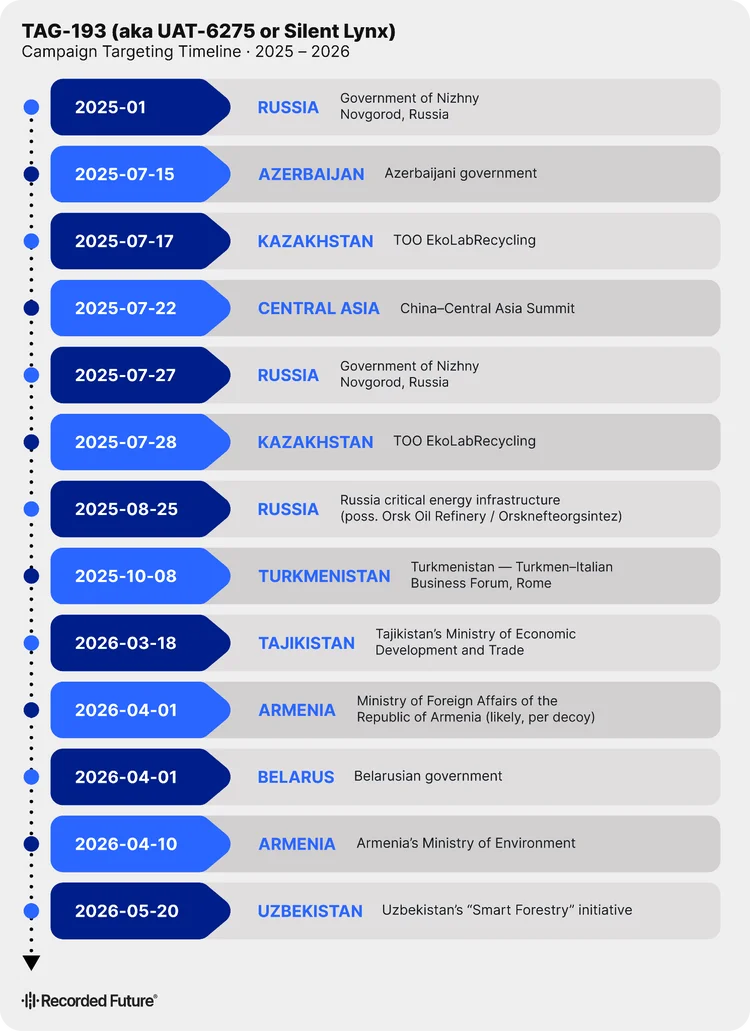
TAG-193 has been actively targeting government institutions across Central Asia, focusing on diplomatic and resource management insights.

Recent analysis from Cisco Talos and Recorded Future’s Insikt Group has revealed persistent cyber-espionage operations linked to TAG-193, also known as Silent Lynx. This group has been zeroing in on government entities throughout Central Asia and the Commonwealth of Independent States (CIS), with a particular focus on sectors like diplomacy, economic policies, and environmental management. Notably, TAG-193's tactics blend targeting of governmental and economic interests, reflecting a strategic approach to leveraging information related to vital regional resources.
Strategic Target Selection
TAG-193’s operations showcase a clear intent to penetrate institutions that influence diplomacy and economic development, agriculture, and environmental sustainability. These targets manage crucial data that can sway negotiations and inform strategic decisions regarding shared resources—such as river systems and energy networks—across Central Asia. This intelligence not only holds local relevance but also carries implications for broader security dynamics in the region.
Understanding the Actors: TAG-193
TAG-193, often referred to as Silent Lynx, operates in a complex geopolitical environment, where the stakes are incredibly high. This group’s focus on government and economic institutions is not incidental; it reflects an understanding of how information can be weaponized in today’s interconnected world. Cyber-espionage has become a tool for state and non-state actors alike, empowering them to gather intelligence that influences all facets of governance and resource management.
In Central Asia and the CIS, governments grapple with issues surrounding energy security, resource allocation, and environmental stability. This creates a rich target environment for cyber-espionage operations like those conducted by TAG-193. If you're working in this space, it’s imperative to recognize how cyber threats can disrupt not just individual businesses but entire national agendas. The group has demonstrated a sophisticated understanding of both the technical and political landscapes it operates within.
Technical Tactics Employed by TAG-193
The cyber tools and methods employed by TAG-193 are noteworthy. Analysis suggests they use advanced persistent threats (APTs) that are difficult to detect. This use of sophisticated malware, phishing approaches, and social engineering tactics allows them to infiltrate networks and extract sensitive information with relative ease. The interplay between human error and technical vulnerabilities creates ample opportunities for groups like TAG-193 to achieve their objectives.
Moreover, it's not just about stealing information. Cyber-espionage can also involve planting misleading data or altering existing information to create confusion within target organizations. It’s an unsettling reminder of the dual-use nature of cyber capabilities. That said, while TAG-193’s targets are primarily governmental, the ripples of their actions can reach into private sectors and international relations, further complicating an already volatile regional atmosphere.
Sectoral Vulnerabilities and Implications
The sectors that TAG-193 is increasingly targeting—diplomacy, economic development, and environmental management—are characterized by significant data sensitivity. Intelligence gathered from these sectors can lead to competitive advantages, undermine trust between nations, and disrupt multilateral negotiations. For instance, when dialogues around shared water resources or energy supplies are threatened by misinformation, the potential for conflict grows exponentially.
Moreover, the implications of TAG-193's focus are not limited to a singular narrative. Countries in Central Asia often rely on cooperation for resource management, making any breach of trust or leaking of sensitive negotiations particularly destabilizing. These cyber operations aren't just theft; they're part of a broader strategy that influences the equilibrium of power in the region. The psychological impact of residing under constant surveillance and threat of hacking should not be dismissed either.
Looking Ahead: The Future of Cyber-Espionage in Central Asia
The ongoing campaigns by TAG-193 may herald a new era of heightened cybersecurity measures across Central Asia and the CIS. Governments will likely need to fortify their defenses, investing in cybersecurity solutions that not only combat these immediate threats but also prepare for future vulnerabilities. With the stakes as high as they are, the urgency for proactive measures has never been clearer.
Investment in human capital is central to this effort. Training programs focused on cybersecurity awareness and data management can help mitigate risks. Organizations must emphasize a culture of caution where employees are encouraged to recognize phishing attempts and other social engineering tactics deployed by groups like TAG-193. Awareness is power—this is the part most people overlook.
Furthermore, international collaboration is essential. Countries facing similar threats need to share intelligence and strategies in order to effectively counteract these cyber threats. An isolated response won’t suffice in an interconnected cyber world. As governments come to terms with their vulnerabilities, the focus should shift from merely reactive approaches to proactive partnerships that reinforce collective security.
Conclusion: What This Means for the Future
TAG-193 is emblematic of a troubling trend in cyber-espionage operations that target government and economic interests. The implications stretch far beyond what’s visible in daily operations, affecting regional security dynamics and intergovernmental relations. As they continue to evolve, these tactics serve as a reminder that in the digital age, the battleground is not just physical but also intangible. For governments, businesses, and citizens, vigilance and collaboration will be key in navigating the murky waters of this cyber threat landscape.
Discussion
Sign in to join the discussion.