T-Head’s Zhenwu V900 chip boasts impressive performance and memory capacity, paving the way for a new era in integrated AI infrastructure solutions.
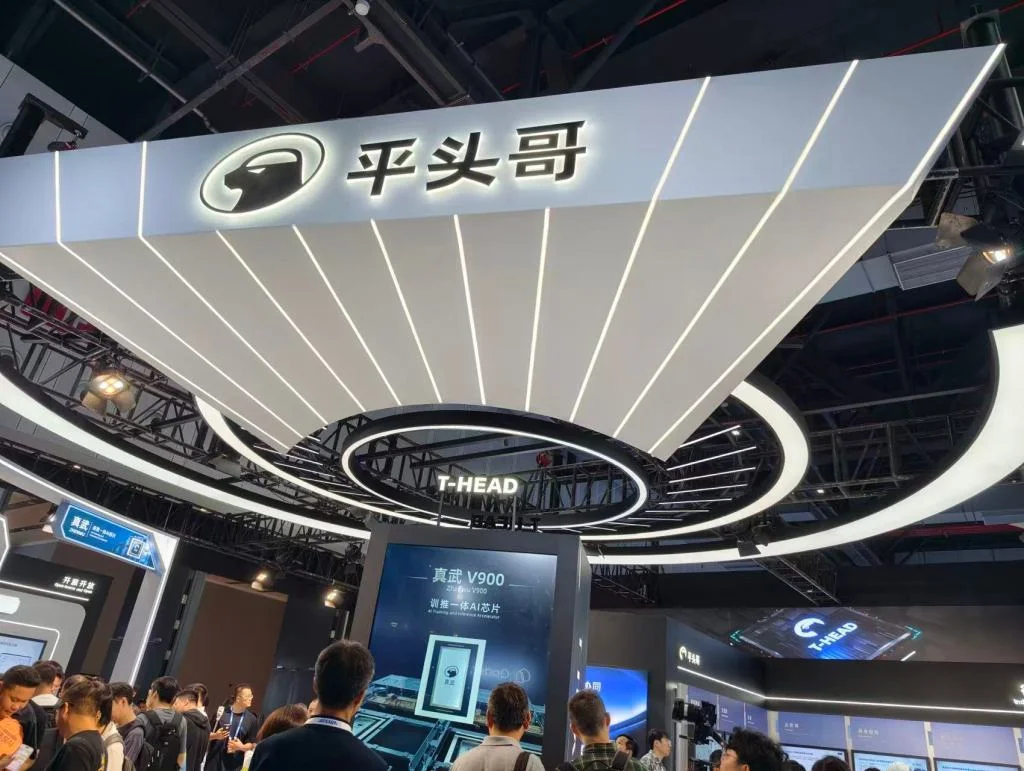
Unveiling the Zhenwu V900
T-Head, a subsidiary of Alibaba that concentrates on chip development, has launched its latest high-performance AI chip, the Zhenwu V900, at the 2026 Apsara Conference held in Hangzhou. This advancement signifies a critical shift for T-Head as it broadens its focus from merely producing individual AI accelerators to a more comprehensive chip strategy that incorporates computing, storage, and networking elements. This pivot is essential as AI applications continue to evolve and require more integrated solutions to match their growing complexity.
Performance Enhancements and Features
The Zhenwu V900 reportedly outperforms its predecessor, the Zhenwu M890, by a factor of three. This positioning makes it T-Head's most advanced AI chip to date. It sports an impressive 216GB of memory, providing developers with substantial resources to run complex models. More notable is its inter-chip bandwidth of 1,200GB/s, which is crucial for high-speed data transfer among chips, effectively minimizing bottlenecks that can hinder performance. Additionally, the V900 has been designed to handle low-precision computations, particularly FP8 and FP4 formats. These formats are pivotal for optimizing efficiency in specific workloads, enabling faster calculations and minimizing inference costs—a point that cannot be overlooked and signifies a vital step for companies looking to maximize their AI infrastructure.
Integration and Scalability
Designed for a larger system architecture, the V900 employs proprietary ICN Switch interconnect chips, allowing multiple V900 units to form supernodes. This configuration not only supports unified memory addressing but also ensures full-bandwidth interconnectivity across extensive networks of AI chips. T-Head claims that over 1,000 V900 chips can work together as a single unit, which is significant. This scalability makes the V900 particularly suited for training complex models and addressing the vast demand for AI-driven inference that organizations face today. If you're working in this space, you'll appreciate how networked chip solutions can amplify processing capabilities exponentially, which is increasingly necessary for sophisticated AI tasks.
Supporting Infrastructure
During the conference, Alibaba also showcased a supernode server integrating the V900 with several other components, including the ICN Switch and Panmai smart NIC. This cohesive architecture enables a more unified system that enhances operational efficiency. Additionally, T-Head’s AI computing cluster can scale up to 500,000 accelerators, a powerful figure that greatly expands its capability to manage large AI workloads. With such infrastructure, T-Head is positioning itself as a formidable player in an increasingly competitive market.
Commercial Applications and Historical Context
The strategy leading up to this launch has been unfolding for some time. Systems utilizing the earlier Zhenwu M890 chip have already found widespread commercial applications, supporting AI models that exceed 2 trillion parameters. These systems have integrated into platforms like Qwen3.8 and Kimi K3, which are accessible via Alibaba Cloud’s Bailian platform. Notably, T-Head has engaged over 650 enterprise clients across various sectors, including finance, autonomous driving, and manufacturing. This broad engagement establishes a solid market foothold, demonstrating that businesses are actively seeking scalable and efficient AI solutions.
Future Outlook for CPU Development
Alongside the advancements in AI chips, T-Head has unveiled a roadmap for its Yitian server CPUs, including the upcoming Yitian 720 and Yitian 730, set to debut in Q3 2027. These CPUs will focus on enhancing single-core performance and energy efficiency. The Yitian 730 is expected to achieve up to 1.4 times the performance of its predecessor, the Yitian 710. This focus on performance aligns with the ongoing demand for more efficient processing power in a competitive global market that requires not just speed but also energy consciousness—a combination vital for sustainable technology development.
Strategic Approach to AI Infrastructure
Looking ahead, the forthcoming Yitian 750 is set to introduce T-Head’s ICN inter-chip protocol, allowing direct communication with Zhenwu chips. This strategic move indicates a deeper integration of CPU and AI accelerator designs, moving from the previously more loosely connected chipsets to a more cohesive system architecture. Such steps reflect the industry's shifting needs as AI models and inference demands grow, where effective inter-chip communication and memory access are paramount. This might be the part most people overlook, but it underscores a fundamental evolution in chip design that aligns with future trends.
Preparation for Mass Production
Mass production for the V900 is anticipated to commence by Q1 2027. This timeline is significant as it positions the chip to play a key role in bolstering T-Head’s annual shipments of AI chips, as its market presence continues to expand. At the Apsara Conference, T-Head also hosted hands-on workshops showcasing its T-Head SAIL software stack, which encompasses model training, inference, and software enhancements. Having a strong software ecosystem to complement the hardware advancements is vital for attracting developers and businesses to this platform.
Looking Ahead for China's AI Chip Sector
The introduction of the Zhenwu V900 exemplifies T-Head's ambitions and signals a broader trend within China’s AI chip sector focused on systemic infrastructure. This strategy aims to enhance competitiveness by integrating accelerator performance with essential memory and interconnect solutions crucial for managing larger AI models. It reflects a growing recognition that building comprehensive ecosystems—not just stand-alone products—is key to thriving in the fast-scaling AI market. The future looks promising, but the road ahead will require continuous innovation and adaptation amid ever-increasing demands for AI capabilities.
Discussion
Sign in to join the discussion.