Recorded Future's AI Alert Filtering streamlines security operations by prioritizing alerts, helping analysts focus on threats that truly matter.

Recorded Future has rolled out its AI Alert Filtering feature, designed to streamline the workflow for security analysts by automating the initial assessment of alerts based on relevance. This tool addresses the increasing complexity of threat intelligence generated in today's digital sphere, particularly as cybercriminals leverage AI to enhance their attacks. The introduction of such a feature underscores a growing trend where technology is attempting to keep pace with the aggressions of cyber threats. Analysts are constantly bombarded with a deluge of alerts that often vary in importance, making it essential to distinguish between genuine threats and noise within a security context.
As threats evolve and proliferate, the sheer volume of alerts becomes overwhelming. Recorded Future's AI Alert Filtering responds to this challenge by sifting through alerts and highlighting those that warrant immediate attention. Early adopters have reported an impressive reduction in alert volume by roughly 63%. While that sounds promising, it's essential to recognize that individual results may vary depending on specific configurations and use cases. With cyber attacks becoming more sophisticated by leveraging techniques like automation and machine learning, finding a way to effectively filter and prioritize alerts could make all the difference in mitigating potential breaches.
Efficient Prioritization of Alerts
Utilizing Recorded Future AI, this filtering mechanism relies on the Intelligence Graph® to provide context and classification for each alert. This graph acts as a knowledge base that accumulates information over time, enriching the alert assessment process. It sorts alerts into high and low relevance categories, ensuring analysts can quickly focus on the most pertinent information. The classification not only summarizes the alerts, but it also elucidates the reasoning behind its relevance determinations. It’s that reasoning component which is often overlooked—understanding the ‘why’ of an alert is just as critical as the ‘what’.
Core Features of AI Alert Filtering
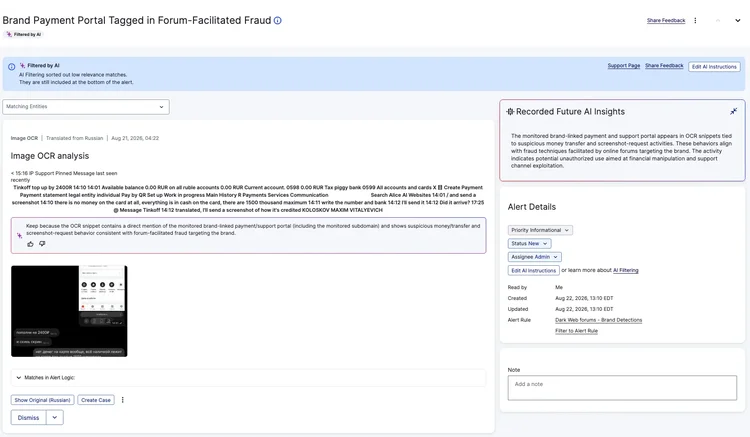
- Relevance Categorization: Alerts are divided into 'High Relevance' and 'Low Relevance' sections. Analysts initially view only high-relevance alerts, significantly reducing cognitive load in a field known for mental fatigue from information overload.
- Alert Summaries: Each alert now comes with an AI-generated summary. This adds a layer of efficiency, enabling analysts to swiftly ascertain which alerts require immediate action rather than digging through each one painstakingly.
- Customizable Intent: Users can set specific priorities according to their needs. For instance, defining intent for distinct entities allows for focused results without necessitating a complete rule overhaul—a notable convenience.
- Auto-Dismissal of Empty Alerts: Alerts that don’t meet established relevance criteria can be automatically dismissed, an advantage that helps keep queues uncluttered while still retaining original details for later review.
- Retained Original Data: Perhaps most importantly, the system changes the display of alerts without losing any original data. Analysts can still access complete, unfiltered alert details within the portal. This accessibility ensures that while filtering might prioritize, it doesn't eliminate valuable context.
Implications for Security Analysts
This functionality's significance can't be overstated. For professionals in cybersecurity, every second counts when it comes to assessing threats. If you're working in this space, you'll recognize that traditional methods of alert management often lead to burnout among analysts, as they struggle to keep up with the constant barrage of data. Quality over quantity is a mantra often parroted in various industries, but in cybersecurity, it can literally mean the difference between thwarting an attack and facing a breach.
Moreover, the flexibility offered through customizable intent means that organizations can adapt the AI filter according to their unique operational needs. This adaptability stands in stark contrast to more rigid systems that often fail to account for different threat profiles or organizational structures. In this context, the AI Alert Filtering could be a step towards more personalized, effective security measures. That said, there will undoubtedly be a learning curve for teams accustomed to the previous methods, and it will take time to fully realize these operational efficiencies.
In an era where AI is becoming a central player not just in cybercriminal activities but also in defense, organizations must embrace these advancements with a critical eye. What this means for you is that while these features offer promise, ongoing evaluation of their effectiveness in different contexts is essential. Analysts need to remain vigilant—not just against external threats, but also in how these tools shape their workflows and decision-making processes.
Looking ahead, as cyber threats continue to evolve, the capabilities of such filtering tools will likely need to expand in parallel. The AI Alert Filtering by Recorded Future might just be the starting point of a larger movement toward automated, AI-driven security measures that allow human analysts to zero in on higher-level strategy and incident response without being bogged down by minutiae.
Discussion
Sign in to join the discussion.